A compare/contrast analysis across three distinct eras — drawn from transcripts, videos, and public statements documented in the Klein v. Samsen case materials. This is not a gotcha; it's a timeline of how positions shifted, what stayed consistent, and where contradictions emerged.
During this period, Klein's use of the word "genocide" appeared sincere and emotional — particularly the Oct. 12 episode where he cried on camera. These statements were not defensive or strategic; they emerged organically in conversation.
Klein's early criticism of the IDF was personal and grounded in Hila's experience. He didn't treat the IDF as a sacred institution. This will contrast sharply with how he later handles criticism of Hila's IDF service.
Notable detail: Klein donated to Palestinian causes on Hasan's stream. The two were still on good terms. The personal relationship clearly influenced Klein's public posture on the conflict. This is worth tracking.
The shift is gradual but significant. In Oct 2023, Klein held both horrors simultaneously. By the Content Nuke era, Oct 7th became the lens through which everything else was filtered, and Palestinian suffering became something acknowledged in passing rather than centered.
This is the crux of the evolution. Regardless of whether Klein's specific facts about these groups are accurate (many are), the question is: what's the function of spending an hour delegitimizing every armed resistance movement fighting Israel during an active genocide? Klein doesn't grapple with why these groups exist, what they're resisting, or the international law framework around occupied peoples' right to armed resistance. The Houthis' blockade — the most concrete action any state took to pressure Israel — is treated purely as piracy and terrorism rather than as an attempt to enforce consequences for genocide. You can acknowledge that the Houthis are deeply flawed and still recognize what their blockade was responding to. Klein doesn't do this.
This asymmetry is one of the strongest pieces of evidence for the argument that Klein applies different evidentiary standards depending on which side is being accused. The UN Report does support that sexual violence occurred — this is not fabricated. But the double standard in how Klein treats allegations against each side is notable. He demands extraordinary evidence for Israeli crimes while treating Israeli-sourced claims about Palestinian crimes as self-evident.
This is a key marker of the shift. In 2020, Klein told Trisha Paytas to take "Free Palestine" seriously. By 2024–2025, he was treating Palestinian liberation slogans as antisemitic. The same man who said "genocide" and "apartheid" in 2020 now treats the people resisting that genocide and apartheid as the aggressors.
The complaint essentially says: "I said 'genocide' several times and donated money, therefore I cannot be accused of backing genocide." This treats the question as binary — either you actively cheer for dead children or you're fully pro-Palestinian. It doesn't engage with the possibility that someone can nominally condemn a genocide while spending the vast majority of their platform energy attacking the people and movements fighting against it. The donations are real. The tears were real. But they coexist with a 1.5-hour documentary whose entire purpose was to delegitimize anti-genocide activists and the armed resistance movements opposing the genocide.
The two-state framing deserves scrutiny on its own terms. A two-state solution as currently envisioned by liberal Zionists would preserve Israel as an ethnostate with a Jewish demographic majority — which is the structural condition that produced the ongoing Nakba, the apartheid system, and the genocide. Whether you agree with that analysis or not, it's the mainstream position of virtually every major Palestinian rights organization and most international law scholars working on the conflict. Klein's complaint characterizes the anti-colonial position — that a settler-colonial ethnostate should be replaced with an equal, democratic state — as "genocide of Israelis." This is itself a form of the very propaganda Klein is accused of spreading: equating the end of a political system with the extermination of a people.
This is perhaps the single clearest example of Klein functioning as a conduit for Israeli propaganda. The Great March of Return is one of the most well-documented cases of Israeli massacre of peaceful protesters. Human rights reports were unambiguous. Klein's framing — that there was "Hamas activity" and people "attacking the fence" — is the exact justification Israel used for shooting unarmed protesters hundreds of meters from the barrier. The man who cried over a dead Palestinian child in 2023 was, by 2024, explaining why Israel was justified in sniping Palestinian children.
The double standard is the point. A 19-year-old from a country experiencing genocide (US-Saudi war on Yemen) who supports his country's government = terrorist. An Israeli woman who volunteered for a combat battalion conducting raids in illegally occupied territory = victim of mandatory service. This asymmetry — where the occupied are terrorists and the occupiers are victims — is the structural logic that enables genocide. You don't have to agree with the Houthis' politics to see that Klein applies the word "terrorist" along ethnic and national lines rather than based on consistent principles.
The donations are real and they matter — they help actual Palestinians. But they also reveal the contradiction at the heart of Klein's position. He donates to organizations helping Palestinians survive the genocide while simultaneously producing content that delegitimizes every movement trying to stop the genocide. It's the equivalent of donating to a cancer charity while attacking the doctors performing surgery. Humanitarian aid without political solidarity becomes a way to feel good about yourself while the structural violence continues. Palestinians don't just need food — they need the occupation, apartheid, and genocide to end. Klein actively works against the people and movements fighting for that.
What emerges from the transcripts is not a simple story of a man who supports genocide or a man who opposes it. It's the story of someone whose positions are shaped more by personal relationships and interpersonal conflict than by consistent political principles.
When Klein was friends with Hasan, he called Israel's actions genocide, cried on camera, donated to Palestinian causes on Hasan's stream, and criticized the IDF. After the breakup, his stated position remained nominally the same — he still occasionally says "genocide" and "apartheid" — but his actions, emphasis, and energy shifted dramatically toward attacking anti-genocide activists, delegitimizing armed resistance movements, echoing IDF talking points, conflating anti-Zionism with antisemitism, and producing the most elaborate piece of content he's ever made (the Content Nuke) whose sole purpose was to characterize the most prominent pro-Palestinian voice on the internet as a terrorist sympathizer.
The question isn't whether Klein has ever said the right words. He has. The question is whether saying "genocide" a few times while spending hundreds of hours and your biggest production attacking the people fighting the genocide constitutes "backing" it in any meaningful sense. That's a political and moral question — not a legal one. And it's the question at the heart of this case.
One final note: none of this means anyone has "the" right position. The conflict involves genuine complexity around security, displacement, identity, and justice that no YouTube personality is going to solve. But the false equivalence between an occupied people and their occupier — between the violence of resistance and the violence of occupation — is not neutrality. It's a choice. And Klein has made that choice increasingly clearly, even as he insists otherwise.
The legal mechanics of Klein v. Samsen aren't just procedural — they reveal how each side understands the relationship between speech, truth, and political accountability. Here's a framework for following the case without getting lost in the jargon.
Before anything else happens in this case, Samsen will almost certainly file an anti-SLAPP motion under California Code of Civil Procedure § 425.16. This is the single most important procedural moment in the entire lawsuit, and it will likely determine whether the case lives or dies.
What anti-SLAPP does: California created this statute to prevent wealthy plaintiffs from using the lawsuit process itself as a weapon against free speech. "SLAPP" stands for Strategic Lawsuit Against Public Participation. The idea is that even if you eventually win a defamation case, the cost of fighting it — lawyers, depositions, years of litigation — can destroy someone financially. Anti-SLAPP lets defendants get speech-based lawsuits thrown out early, before that financial destruction happens.
Why it matters here: If Samsen wins the anti-SLAPP motion, the case is dismissed and Klein will almost certainly be ordered to pay Samsen's attorney's fees. That's mandatory under the statute. It's designed to make plaintiffs think twice before filing suits that target protected speech.
The anti-SLAPP motion is a two-step process, and each step is its own battleground with different burdens:
Samsen must show that his video constitutes speech on a matter of public concern. This is almost certainly an easy win for him. A YouTube video essay analyzing how public figures covered the Israel-Palestine conflict — a matter of global public concern involving public figures who voluntarily entered the debate — is textbook protected activity. Klein's lawyers probably won't seriously contest this step.
This is where it gets hard. Once Samsen clears Step 1, the burden shifts to Klein. He must demonstrate a "probability of prevailing" on his defamation claim — meaning he has to show enough evidence that a reasonable jury could find in his favor on every element: that the statements are factual assertions (not opinion), that they're false, that they caused damage, and that they were made with actual malice (the highest legal standard, required because Klein is a public figure). This isn't a full trial — he doesn't have to prove his case. But he has to show it's not frivolous.
Here's where the competing logics collide. Both sides are invoking values that sound like they should be on the same team — free speech, accountability, truth — but pulling in opposite directions:
This is the core of the brain-jumble — and it's genuinely hard, not because anyone is dumb, but because the line between fact and opinion is inherently blurry in political speech. Courts have to sort statements into categories that language doesn't always respect.
Consider this spectrum using the actual statements from the complaint:
Whether someone "backed" a genocide through their rhetoric is an interpretive political judgment. Courts generally treat headlines and titles as protected expression when the underlying work explains the reasoning. Samsen's video is an hour-long argument for why this conclusion is warranted. This is Klein's weakest claim.
Calling someone's political characterization "misinformation" or "lies" — is that a factual claim or rhetorical emphasis? It sounds factual, but in the context of a political debate about contested groups, a court might treat it as a charged way of saying "I think he's wrong." The word "lies" implies knowledge of falsity, which pushes it toward factual territory. But political commentators call each other liars constantly. This could go either way.
This is a specific factual claim about what a public document says. Either the UN Report "denies" the allegation or it doesn't. The complaint argues that paragraphs 84–86 of the Report found "reasonable grounds to believe" sexual violence occurred — meaning Samsen's characterization that the report "denies" it is provably false. This is Klein's strongest claim because it's verifiable against the actual document.
Even if Klein gets past the fact/opinion question on some claims, he still faces the actual malice standard — and this is where many public-figure defamation cases die.
Actual malice doesn't mean "Samsen was mean" or "Samsen didn't like Klein." It means Samsen made the statements knowing they were false or with reckless disregard for whether they were true or false. Being wrong isn't enough. Being sloppy isn't enough. Being biased isn't enough. Klein has to show Samsen either knew the truth and deliberately said the opposite, or that the truth was so obvious that only a reckless person would have gotten it wrong.
The complaint tries to build actual malice through several threads:
Klein argues that Samsen cited specific sources (the UN Report, the Al-Jazeera Documentary, the Bad Empanada video) and then misrepresented what those sources actually say. If true, this is strong malice evidence — it suggests Samsen either didn't read his own sources (reckless disregard) or deliberately distorted them (knowledge of falsity). The UN Report argument is the cleanest version of this: the report says "reasonable grounds to believe" sexual violence occurred, but Samsen characterized it as "denying" the allegation.
Samsen admitted on video (May 15, 2025) that he included Klein in the thumbnail because it would generate more views. The complaint frames this as evidence of malice — that Samsen knew Klein didn't support genocide but labeled him that way for algorithmic benefit. But this is weaker than it sounds. Samsen's own explanation was that he uses creator drama to draw audiences toward genocide awareness — a cynical but coherent editorial strategy. Clickbait isn't malice.
After receiving a 16-page retraction demand with detailed evidence of falsity, Samsen refused to retract, called it a "joke," and doubled down. In California, continuing to publish statements after being presented with evidence of their falsity can be used as evidence of actual malice. This is real — but Samsen's counter is that he reviewed the evidence and disagreed with it, which is different from ignoring it.
Klein argues that Samsen relied on Bad Empanada — a source with a documented history of extreme hostility toward Klein, Israel, and Israelis — and that this reliance shows reckless disregard for truth. This is an interesting argument because courts have held that relying on clearly biased sources can contribute to a malice finding. But Samsen would counter that Bad Empanada's political positions don't make his factual claims wrong, and that Klein is trying to discredit a source based on ideology rather than accuracy.
Here's where the legal analysis connects back to the position tracker above. The complaint itself is a document that performs the same pattern we identified in Klein's public positions.
The legal strategy requires Klein to present himself as unambiguously pro-Palestinian — someone who has always condemned the genocide, always supported Palestinian rights, always criticized Israel. The complaint assembles every donation, every use of the word "genocide," every tear shed on camera into a narrative of consistent advocacy. It needs to do this because the legal claim depends on falsity: Samsen said Klein backed the genocide, so Klein must prove he didn't.
But the complaint has to leave out everything documented in the position tracker above — the Content Nuke, the attacks on resistance movements, the double standards on evidence, the conflation of anti-Zionism with antisemitism, the Great March of Return apologetics, the characterization of a Yemeni teenager as a terrorist. None of that appears in the complaint. It can't, because it would undermine the narrative.
This is exactly what Samsen will argue: that Klein's pro-Palestinian statements are the shield deployed to protect the substance of his content, which functionally serves Israeli narratives. The lawsuit literalizes this dynamic — the shield becomes a legal document.
Whether a court finds that persuasive is another question entirely. Courts aren't in the business of evaluating political sincerity. But for those of us trying to understand what's actually happening in this conflict and in this case, the gap between the complaint's version of Klein and the full record is the story.
This case is at the complaint stage. Samsen hasn't filed his response yet. The anti-SLAPP motion — if filed — will be the first real test of whether these claims survive judicial scrutiny. The outcome will turn on whether a California judge sees Samsen's statements as protected political commentary or as provably false factual assertions made with reckless disregard for truth.
What to watch for: The anti-SLAPP motion and ruling (likely the most consequential moment in the case). Whether Klein's team can present admissible evidence of actual malice at the anti-SLAPP stage without full discovery. How the court treats the spectrum from pure opinion ("backed a genocide") to specific factual claims (the UN Report characterization). And whether Samsen's post-retraction-demand conduct (doubling down, taunting Klein to sue) is treated as evidence of malice or protected defiance.
This document will be updated as the case develops. The analysis here reflects what's available in the public record as of the filing date. If you're reading this and something is wrong, missing, or unfair — that's a feature of works-in-progress, not a defense against criticism. Corrections welcome.
The dispute at the center of this lawsuit — how to characterize what happened on October 7th and what's happening in Gaza — touches on questions that real people are suffering through right now. These are the key primary sources. They're presented here not to tell you what to think, but to give you the tools to evaluate the claims being made by all parties. Read them. They deserve more than anyone's summary.
What it is: A 23-page report from the UN Office of the Special Representative of the Secretary-General on Sexual Violence in Conflict. Led by Pramila Patten with a nine-person technical team including a forensic pathologist and SGBV investigators. This is a fact-finding mission, not a criminal investigation — the report says this explicitly.
What it found: "Reasonable grounds to believe" that conflict-related sexual violence including rape and gang rape occurred at the Nova music festival, along Road 232, and at Kibbutz Re'im. "Clear and convincing information" that some hostages in Gaza were subjected to sexual violence including rape. The report also documented sexual violence by Israeli forces against Palestinians in the West Bank, including invasive body searches, forced nudity, threats of rape, and beatings in genital areas.
What it didn't find or couldn't establish: The prevalence or scale of sexual violence. Specific attribution to particular armed groups. Any digital evidence of sexual violence despite reviewing 5,000+ photos and 50 hours of footage. A discernible pattern of targeted genital mutilation. At least two widely publicized allegations at Kibbutz Be'eri were determined to be unfounded. The report noted significant problems with non-professional forensic interpretations by untrained first responders.
What it explicitly warned against: "Political instrumentalization" of sexual violence findings — see Recommendation (f).
Critical limitation: The report acknowledged its information was "in large part sourced from Israeli national institutions" due to the absence of UN entities in Israel, and that Israel simultaneously blocked access to the bodies with actual investigative mandates (the IICOI and OHCHR).
How it's used in this lawsuit: Klein's complaint cites Paragraphs 84–86 to argue he accurately represented the report's findings. Samsen characterized the report as "denying" the "Hamas mass rapes allegation." Neither characterization fully captures the report's careful, tiered, heavily-caveated language. The report is the key document in what may be Klein's strongest defamation claim (the Fifth Defamatory Statement).
Source: Available at news.un.org. Search: "Mission report SRSG-SVC Israel occupied West Bank January February 2024"
What it is: A 33-page report from a Washington DC-based sexual violence prevention nonprofit, applying a framework called SORVO (Systemic Oppression, Reverse Victim and Offender) to the Israel-Palestine conflict. The framework was previously applied to Jim Crow-era America, apartheid South Africa, and the Nazi Holocaust. Funded in part by HEART To Grow, a Muslim survivor advocacy organization.
What it argues: That Israel employs eight narrative manipulation tactics — exaggerating, sensationalizing, redefining, and falsifying Palestinian sexual violence against Israelis while denying, omitting, erasing, and de-defining Israeli sexual violence against Palestinians. The report positions this as a documented pattern in which oppressive groups weaponize sexual violence allegations to justify collective punishment.
Key data: The SVPA analyzed 65 articles in the New York Times and Politico mentioning sexual violence in this conflict (Oct 7, 2023 – Oct 7, 2024). Of those, 66% focused on sexual violence against Israelis, 22% on sexual violence against Palestinians, and 12% on both. The report also documents the discredited NYT "Screams Without Words" article (the featured victim's family publicly denied she was raped; the lead reporter had anti-Palestinian social media activity), and the documented cases of Israeli sexual violence against Palestinian detainees including the Sde Teiman incident.
Important nuance: The report explicitly states that "believing survivors is the heart of any movement to end sexual violence" and acknowledges the UN's finding that sexual violence occurred on October 7th. Its analysis is specifically about how those accounts were weaponized — not about whether individual acts occurred. It also acknowledges the antisemitic history of painting Jewish people as sexual predators (used by the Nazi regime) and distinguishes that from its critique of the Israeli state.
Why it matters here: The SORVO framework provides academic language for the dynamic this document tracks in Klein's positions: asymmetric evidentiary standards applied along ethnic and national lines. It also contextualizes the UN Report dispute — the question isn't just "did Samsen misrepresent the report" but "how does the report function within a broader pattern of narrative manipulation around sexual violence in this conflict."
Source: Available at s-v-p-a.org/sorvo-palestine
Several investigative pieces contributed to the evolving understanding of October 7th sexual violence claims. These include The Intercept's investigation into the NYT "Screams Without Words" article (February 2024), which documented internal NYT concerns about the piece's reliability and the lead reporter's social media activity; reporting on the family of Gal Abdush (the "woman in the black dress") publicly disavowing the NYT's central claim; and Electronic Intifada's ongoing documentation including the exposure of key eyewitness Rami Davidian as unreliable by an Israeli journalist, and the Israeli prosecutor's acknowledgment of zero complainants in alleged October 7th rape cases.
A Vanity Fair report (March 2, 2024) revealed what happened inside the NYT when journalists questioned the reporting. After The Intercept published details about internal debate over a pulled "Daily" podcast episode on October 7th sexual violence, the Times launched what the Newsguild union president called a "destructive and racially targeted witch hunt." The leak investigation specifically targeted members of the paper's Middle Eastern and North African Employee Resource Group (the MENA Collective), subjecting them to "particularly hostile" questioning. Some employees brought in had no connection to the podcast — their only link was having raised concerns with the standards editor about the original December article. MENA Collective members were ordered to hand over membership lists and personal communications. The union stated that while the Times has the right to conduct investigations, "they do not have the right to intimidate or target their members because of their race, ethnicity, or views." This is significant because it shows narrative control operating not just in what gets published, but in the institutional suppression of dissent from journalists — particularly journalists of Middle Eastern and North African descent — who questioned the reporting from the inside.
These sources have their own editorial perspectives and should be read critically — as should all sources on this topic. They are included here because they document specific factual developments (family disavowals, witness credibility problems, prosecutorial admissions, institutional retaliation against dissenting journalists) that are relevant to evaluating the claims in the lawsuit, regardless of the outlet reporting them.
Every source on this topic — including this document — has a perspective. The UN Report was conducted at Israel's invitation, relied largely on Israeli institutional sources, and could not access Gaza. The SORVO report comes from an organization whose framework presupposes an oppressor/oppressed dynamic. The Electronic Intifada is a Palestinian advocacy publication. Klein's complaint is a legal document designed to present his case in the most favorable light. Samsen's videos are political commentary with a clear ideological commitment.
None of that means any of them are wrong. It means you should read each one knowing what it is, who produced it, and what it's trying to do — and then evaluate the specific claims on their merits. The suffering documented in these sources is real on all sides. The question this lawsuit raises — and that these sources illuminate — is not whether suffering occurred, but how narratives about suffering are constructed, who benefits from those constructions, and what happens when those narratives are used to justify further violence.
If you're encountering this material for the first time: take breaks. This is heavy. The content warnings in the SORVO report exist for a reason, and they apply here too.
Full transcripts of videos cited in the complaint. Numbers in brackets correspond to complaint footnotes. Organized by channel.
PDFs and images cited by exhibit number in the complaint. Numbers in brackets correspond to complaint references.
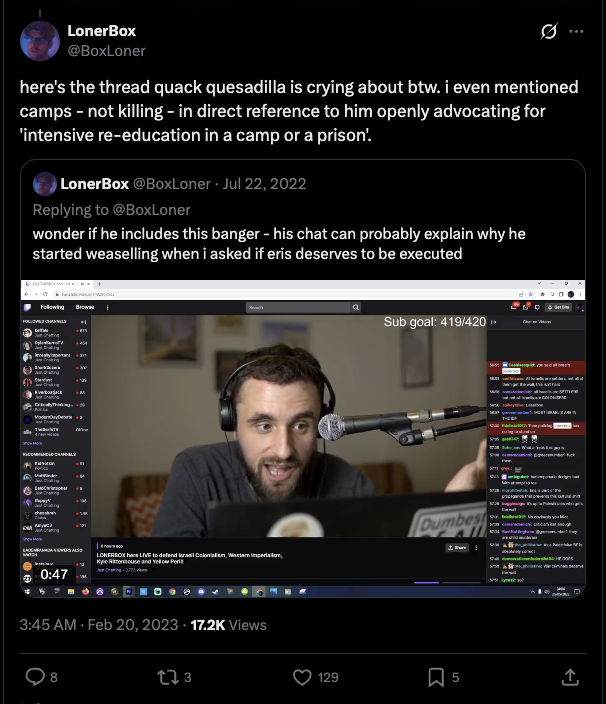
Tweets, posts, and social media screenshots cited in the complaint.
.jpg)
.png)